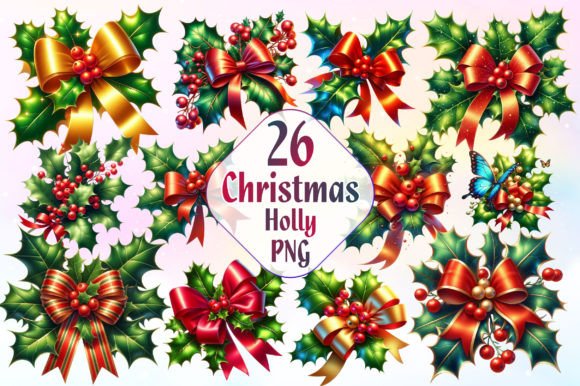
Reviewing Watercolor Christmas Holly Clipart for Stitching
As an embroidery designer who has spent years translating digital art into thread, I approach every new asset with a mix of curiosity and caution. The holiday season brings a flood of festive graphics, but few manage to balance artistic flair with technical stitchability. Recently, I evaluated the Watercolor Christmas Holly Clipart to determine if it holds up under the needle. This isn’t just about whether the image looks pretty on a screen; it is about how it performs as a functional machine embroidery design or a printed element in a high-quality handmade product.
First Impressions: Mood and Visual Personality
The immediate appeal of this Illustrations piece lies in its soft, organic aesthetic. Unlike rigid vector graphics that can feel cold or overly commercial, the watercolor style introduces a sense of warmth and nostalgia. The bleeding edges and varied saturation of the greens and reds create a mood that is both elegant and approachable. For an embroidery project, this visual personality suggests a departure from traditional, dense satin stitching. It invites a more nuanced approach, perhaps utilizing blended thread colors or combining machine stitching with hand-finishing touches to mimic the fluidity of paint.
When I first placed the design against a neutral linen background, the contrast was striking yet gentle. The layout feels balanced, with the holly leaves and berries arranged in a way that guides the eye naturally. This is crucial for custom apparel and home decor, where the design must complement the fabric rather than overpower it. The detail level is moderate, avoiding the microscopic intricacies that often cause threading nightmares, while still offering enough complexity to look professional and intentional.
Real-World Application: From Screen to Stitch
To truly test the viability of the Watercolor Christmas Holly Clipart, I imagined a specific real-life scenario: creating a set of premium holiday tote bags for a boutique client. The goal was to produce a tote bag design that felt artisanal and exclusive. In this context, the watercolor effect offers a distinct advantage. If used as a printed transfer combined with embroidered outlines, it allows for rich color gradients that are difficult to achieve with thread alone. Alternatively, if adapted into a full embroidery file, it would require careful digitizing to simulate the watercolor bleed using varying stitch density and thread shades.
For sweatshirt embroidery, the softness of the design pairs beautifully with the textured surface of fleece or cotton blends. A stiff, high-contrast graphic can look out of place on cozy winter wear, but this holly motif integrates seamlessly. It also works well for baby embroidery projects, such as blanket borders or onesie accents, where harsh lines might feel too aggressive. The organic shapes soften the overall look, making it suitable for delicate items intended as personalized gifts.
However, the application changes when considering an embroidered patch. Patches require durability and clear definition. Here, the watercolor style might need to be simplified. I would recommend increasing the contrast between the leaves and berries to ensure the design remains legible at a smaller scale. This adaptation ensures the finished product maintains its visual impact even when viewed from a distance.
Navigating Technical Challenges
While the aesthetic is strong, practical execution requires attention to detail. One must be cautious when applying this design to stretchy fabric or thin materials. The varied densities inherent in a watercolor-style digitization can cause puckering if not properly supported. Using a cut-away stabilizer is essential to maintain the integrity of the fabric, especially for items like tea towels or lightweight shirts that undergo frequent washing.
Dark fabrics present another challenge. The subtle nuances of the watercolor effect rely on light and shadow. On black or navy material, these details can get lost unless the digitizer uses lighter thread shades for highlights or incorporates a white underlay. I always advise testing the design on scrap fabric first, specifically checking thread color contrast against the intended background. A running stitch outline might help define the edges if the fill areas appear too diffuse on darker textiles.
Additionally, consider the hoop size. If the design is scaled down too much for small hoops, the intricate blending of colors may merge into a muddy blob. It is vital to confirm that the level of detail remains visible at the desired dimensions. For caps and curved surfaces, the design’s placement must be centered carefully to avoid distortion during stitching.
Enhancing Brand Value and Customer Trust
For Etsy sellers and small shop owners, the choice of design assets directly influences brand perception. Using high-quality, thoughtfully selected graphics like the Watercolor Christmas Holly Clipart signals professionalism. It shows that the maker cares about aesthetics and quality, which builds customer trust. In a saturated market, unique design assets help differentiate your small shop product from mass-produced alternatives.
This design also lends itself well to printable mockup creation. Before committing to production, you can visualize how the holly motif looks on various products, from aprons to pillow covers. This step is invaluable for commercial embroidery projects, allowing you to curate a cohesive collection that appeals to your target audience. The versatility of the clipart means it can be used across multiple product lines, ensuring brand consistency while keeping the offerings fresh.
Practical Notes for Designers and Makers
Before integrating this clipart into your workflow, keep these practical tips in mind:
- Test on Scrap Fabric: Always run a test stitch-out to check for tension issues and color blending.
- Check Licensing: Confirm whether the license allows for commercial use if you plan to sell finished items or digital products.
- Evaluate Stitch Density: Ensure the digitized version does not have excessive density, which can damage delicate fabrics.
- Contrast is Key: Use black and white mockups to verify that the design elements are distinct and readable.
- Stabilizer Selection: Match your stabilizer to the fabric type; heavier fabrics may need less support, while knits require robust stabilization.
- Thread Quality: High-quality threads with a slight sheen can enhance the watercolor effect, mimicking the wet look of paint.
In conclusion, the Watercolor Christmas Holly Clipart is a versatile and appealing asset for the modern maker. It bridges the gap between traditional holiday motifs and contemporary design trends. Whether you are creating holiday embroidery for family gifts or developing a new line for your craft business, this design offers the flexibility and charm needed to create standout pieces. By respecting its technical requirements and leveraging its aesthetic strengths, you can produce work that is both beautiful and commercially viable.